Managed security in the UAE: what an MSSP actually does, and when you need one
Buying security tools is easy. Having someone watch them at 2am is the hard part. Here is how managed security works, how it differs from an MDR tool or an in-house SOC, and the signs a UAE business is ready for it.
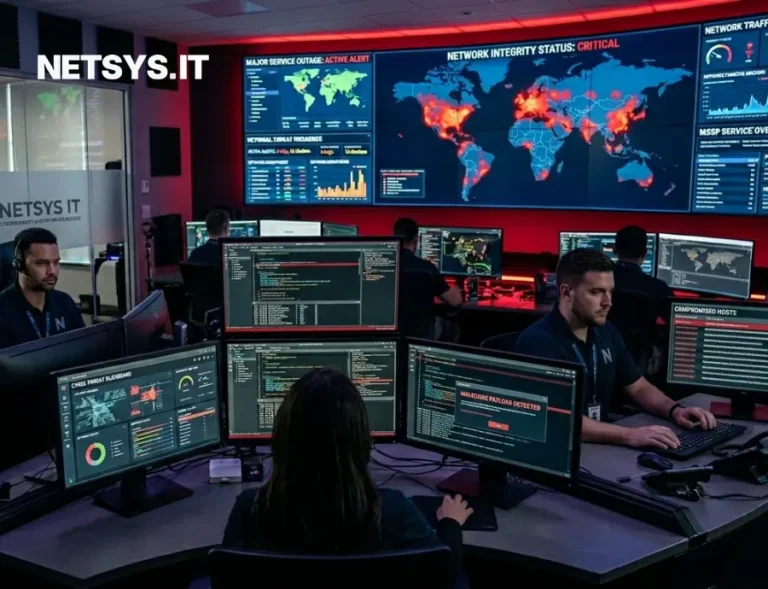
- Most breaches start with an alert nobody was watching, not a missing tool.
- An MSSP gives you the people and process for 24/7 detection and response, not just software.
- For most UAE businesses, a managed service costs far less than building an in-house SOC.
- Look for a local team, Microsoft-first expertise, real 24/7 humans and fixed AED pricing.
Every serious security incident a UAE business faces, from ransomware to a drained bank account, tends to begin the same quiet way: a single alert that nobody looked at in time. The tools were often already in place. What was missing was someone watching them, investigating what mattered and acting before a small signal became a large problem.
That gap is exactly what a managed security service provider is built to fill. It is less about buying more software and more about buying the people, process and round-the-clock attention that turn security tools into actual protection.
What a managed security provider actually is
A managed security service provider, or MSSP, is a company that runs your security operations for you. Instead of expecting your team to monitor for attacks, investigate them and respond at all hours, an MSSP takes that on as a service, backed by a security operations centre (SOC) that never closes.
It is worth separating this from ordinary IT support. General IT keeps systems running and fixes day-to-day problems. Managed security is a dedicated discipline focused on one thing: finding and stopping threats. The two work well together, but they are not the same job, and a helpdesk is not a SOC.
MSSP vs MDR vs SOC-as-a-service
These three terms get used loosely, which makes buying confusing. In plain language:
In practice the labels overlap, and a good provider delivers all three under one agreement so you are not left stitching services together. The question that matters is not the acronym, it is whether real people investigate and respond, or whether you are simply being sold another alert feed.
An alert that nobody sees at 2am is the same as no alert at all. Managed security is about who is watching, not how many tools you bought.
What a managed SOC does day to day
A managed SOC watches the layers attackers actually use: user identities and sign-ins, endpoints and servers, email, cloud services such as Microsoft 365 and Azure, and network activity. Those signals are pulled into a SIEM and correlated, so a suspicious login, an odd email rule and a strange process on a laptop are seen as one attack rather than three unrelated alerts.
When something real surfaces, a disciplined response follows every time:
- Detect. Correlated signals across identity, endpoint, cloud and email surface a genuine threat.
- Validate. An analyst confirms it is real and rules out false positives before anyone is disturbed.
- Contain. The affected host is isolated, the session revoked or the account blocked to stop the spread.
- Recover. Systems and access are restored to a known-good state and the gap is closed.
- Report. You get a clear account of what happened, what was done and what to improve.
Signs your UAE business needs an MSSP
You do not need to be a large enterprise to justify managed security. The clearer signals are practical:
- You have IT staff, but nobody whose actual job is to watch for and respond to threats overnight.
- Your team is stretched keeping the business running and cannot chase every security alert.
- You hold data, run payments or serve clients where a breach would be seriously costly.
- A regulator, client or insurer is asking for monitoring, logging and evidence you cannot currently produce.
- Your current provider only reacts after something breaks, with no real detection or response.
If two or three of these sound familiar, the risk you are carrying is probably larger than the cost of covering it.
Where UAE compliance fits in
Compliance is often the trigger for a first conversation. UAE businesses increasingly need to work toward frameworks such as NESA / UAE IAS, the national information assurance standards; Dubai ISR, the information security regulation for Dubai government and connected entities; ADHICS for healthcare data in Abu Dhabi; and the federal PDPL governing personal data.
A managed security service helps you put the monitoring, logging and reporting behind these frameworks in place, and produces the evidence auditors tend to ask for. One honest caveat is worth stating plainly: aligning with a framework is not the same as holding a certification. A certification or regulatory approval is issued by the relevant authority or an accredited body, and any provider that blurs that line is worth questioning.
What to look for in a UAE MSSP
Once you have decided managed security makes sense, the provider matters more than the brochure. A few things separate a real service from a reskinned alert feed:
- Local presence. A team in your time zone that understands UAE business and can be onsite when needed.
- Real 24/7 humans. Analysts who investigate serious alerts around the clock, not a queue until the next working day.
- Microsoft-first depth. Genuine expertise in Microsoft Sentinel, Defender and Entra, so you get more from tools you already pay for.
- Response, not just alerts. A clear, agreed process for containing and recovering from incidents.
- Fixed, predictable pricing. A clear AED cost, sized to your environment, with no surprises.
How to get started
The simplest first step is to find out what your current setup would actually catch. A short exposure assessment looks at your identities, endpoints, email and cloud, checks for signs of existing compromise, and gives you a prioritised picture of where the real gaps are. From there you can decide how much to hand over and when, rather than committing blind.
Whether you build in-house, buy a point tool or partner with a managed provider, the goal is the same: make sure someone, or something, is genuinely watching, and ready to act, when it counts.